6 Practical Tips on How to Increase Self-Esteem
1. Take a self-esteem inventory to give yourself a baseline.
It can be as simple as writing down 10 of your strengths and 10 of your weaknesses. This will help you to begin developing an honest and realistic conception of yourself.
2. Set realistic expectations.
It’s important to set small, reachable goals that are within your power. For example, setting an extremely high expectation or an expectation that someone else will change their behavior is virtually guaranteed to make you feel like a failure, through no fault of your own.
3. Stop being a perfectionist.
Acknowledge both your accomplishments and mistakes. Nobody is perfect, and trying to be will only lead to disappointment. Acknowledging your accomplishments and recognizing your mistakes is the way to keep a positive outlook while learning and growing from your mistakes.
4. Explore yourself.
The importance of knowing yourself and being at peace with who you are cannot be overstated. This can take some trial and error, and you will constantly learn new things about yourself, but it is a journey that should be undertaken with purpose and zeal.
5. Be willing to adjust your self-image.
We all change as we age and grow, and we must keep up with our ever-changing selves if we want to set and achieve meaningful goals.
6. Stop comparing yourself to others.
Comparing ourselves to others is a trap that is extremely easy to fall into, especially today with social media and the ability to project a polished, perfected appearance. The only person you should compare yourself to is you (Grohol, 2011).
The Positivity Blog also offers some helpful tips on enhancing your self-esteem, including:
- Say “stop” to your inner critic.
- Use healthier motivation habits.
- Take a 2-minute self-appreciation break.
- Write down 3 things in the evening that you can appreciate about yourself.
- Do the right thing.
- Replace the perfectionism.
- Handle mistakes and failures in a more positive way.
- Be kinder towards other people.
- Try something new.
- Stop falling into the comparison trap.
- Spend more time with supportive people (and less time with destructive people).
- Remember the “whys” of high self-esteem (Edberg, 2017).
Another list of specific, practical things you can do to develop and maintain a good sense of self-esteem comes from the Entrepreneur website:
- Use distancing pronouns. When you are experiencing stress or negative self-talk, try putting it in more distant terms (e.g., instead of saying “I am feeling ashamed,” try saying “Courtney is feeling ashamed.”). This can help you to see the situation as a challenge rather than a threat.
- Remind yourself of your achievements. The best way to overcome imposter syndrome—the belief that, despite all of your accomplishments, you are a failure and a fraud—is to list all of your personal successes. You might be able to explain a couple of them away as a chance, but they can’t all be due to luck!
- Move more! This can be as simple as a short walk or as intense as a several-mile run, as quick as striking a “power pose” or as long as a two-hour yoga session; it doesn’t matter exactly what you do, just that you get more in touch with your body and improve both your health and your confidence.
- Use the “five-second” rule. No, not the one about food that is dropped on the ground! This five-second rule is about following up good thoughts and inspiring ideas with action. Do something to make that great idea happen within five seconds.
- Practice visualizing your success. Close your eyes and take a few minutes to imagine the scenario in which you have reached your goals, using all five senses and paying attention to the details.
- Be prepared—for whatever situation you are about to encounter. If you are going into a job interview, make sure you have practiced, know about the company, and have some good questions ready to ask. If you are going on a date, take some time to boost your confidence, dress well, and have a plan A and a plan B (and maybe even a plan C!) to make sure it goes well.
- Limit your usage of social media. Spend less time looking at a screen and more time experiencing the world around you.
- Meditate. Establish a regular meditation practice to inspect your thoughts, observe them, and separate yourself from them. Cultivating a sense of inner peace will go a long way towards developing healthy self-esteem.
- Keep your goals a secret. You don’t need to keep all of your hopes and dreams to yourself, but make sure you save some of your goal striving and success for just you—it can make you more likely to meet them and also more satisfied when you do.
- Practice affirmations (like the ones listed later in this piece). Make time to regularly say positive things about yourself and situations in which you often feel uncertain.
- Build your confidence through failure. Use failure as an opportunity to learn and grow, and seek out failure by trying new things and taking calculated risks (Laurinavicius, 2017).
Now that we have a good idea of how to improve self-esteem, there is an important caveat to the topic: many of the characteristics and factors that we believe result from self-esteem may also influence one’s sense of self-esteem, and vice versa.
For example, although we recommend improving self-esteem to positively impact grades or work performance, success in these areas is at least somewhat dependent on self-esteem as well.
Similarly, those who have a healthy level of self-esteem are more likely to have positive relationships, but those with positive relationships are also more likely to have healthy self-esteem, likely because the relationship works in both directions.
While there is nothing wrong with boosting your self-esteem, keep in mind that in some cases you may be putting the cart before the horse, and commit to developing yourself in several areas rather than just working on enhancing your self-esteem.
Can We Help Boost Self-Esteem Issues with Therapy and Counseling?

Based on research like that described above, we have learned that there are many ways therapy and counseling can help clients to improve their self-esteem.
If done correctly, therapy can be an excellent method of enhancing self-esteem, especially if it’s low to begin with.
Here are some of the ways therapy and counseling can a client’s boost self-esteem:
- When a client shares their inner thoughts and feelings with the therapist, and the therapist responds with acceptance and compassion rather than judgment or correction, this can build the foundations of healthy self-esteem for the client.
- This continued acceptance and unconditional positive regard encourage the client to re-think some of their assumptions, and come to the conclusion that “Maybe there’s nothing wrong with me after all!”
- The therapist can explain that self-esteem is a belief rather than a fact and that beliefs are based on our experiences; this can help the client understand that he could be exactly the same person as he is right now and have high self-esteem instead of low, if he had different experiences that cultivated a sense of high self-esteem instead of low self-esteem.
- The therapist can offer the client new experiences upon which to base this new belief about herself, experiences in which the client is “basically acceptable” instead of “basically wrong.” The therapist’s acceptance of the client can act as a model for the client of how she can accept herself.
- Most importantly, the therapist can accept the client for who he is and affirm his thoughts and feelings as acceptable rather than criticizing him for them. The therapist does not need to approve of each and every action taken by the client, but showing acceptance and approval of who he is at the deepest level will have an extremely positive impact on his own belief in his worth and value as a person (Gilbertson, 2016).
Following these guidelines will encourage your client to develop a better sense of self-love, self-worth, self-acceptance, and self-esteem, as well as discouraging “needless shame” and learning how to separate herself from her behavior (Gilbertson, 2016).
The Benefits of Developing Self-Esteem with Meditation
 Besides clinical interventions, there are also things people can do on their own to boost their self-esteem.
One of these methods is meditation—yes, you can add yet another benefit of meditation to the list! However, not only can we develop self-esteem through meditation, we also gain some other important benefits.
When we meditate, we cultivate our ability to let go and to keep our thoughts and feelings in perspective. We learn to simply observe instead of actively participate in every little experience that pops into our head. In other words, we are “loosening the grip we have on our sense of self” (Puddicombe, 2015).
While this may sound counterintuitive to developing and maintaining a positive sense of self, it is actually a great way to approach it. Through meditation, we gain the ability to become aware of our inner experiences without over-identifying with them, letting our thoughts pass by without judgment or a strong emotional response.
As meditation expert Andy Puddicombe notes, low self-esteem can be understood as the result of over-identification with the self. When we get overly wrapped up in our sense of self, whether that occurs with a focus on the positive (I’m the BEST) or the negative (I’m the WORST), we place too much importance on it. We may even get obsessive about the self, going over every little word, thought, or feeling that enters our mind.
A regular meditation practice can boost your self-esteem by helping you to let go of your preoccupation with your self, freeing you from being controlled by the thoughts and feelings your self-experiences.
When you have the ability to step back and observe a disturbing or self-deprecating thought, it suddenly doesn’t have as much power over you as it used to; this deidentification with the negative thoughts you have about yourself results in less negative talk over time and freedom from your overly critical inner voice (Puddicombe, 2015).
Can You Test Self-Esteem, and What are the Problems with Assessment?
Self-esteem is the topic of many a psychological scale and assessment, and many of them are valid, reliable, and very popular among researchers; however, these assessments are not perfect. There are a few problems and considerations you should take into account if you want to measure self-esteem, including:
- Lack of consensus on the definition (Demo, 1985).
- Overall gender differences in self-esteem (Bingham, 1983).
- Too many instruments for assessing self-esteem, and low correlations between them (Demo, 1985).
- The unexplained variance between self-reports and inferred measures such as ratings by others (Demo, 1985).
Although these issues are certainly not unique to the measurement of self-esteem, one should approach the assessment of self-esteem with multiple measurement methods in hand, with the appropriate level of caution, or both.
Still, even though there are various issues with the measurement of self-esteem, avoiding the measurement is not an option! If you are looking to measure self-esteem and worried about finding a validated scale, look no further than one of the foundations of self-esteem research: Rosenberg’s scale.
Measuring Self-Esteem with the Rosenberg Scale
The most common scale of self-esteem is Rosenberg’s Self-Esteem Scale (also called the RSE and sometimes the SES). This scale was developed by Rosenberg and presented in his 1965 book Society and the Adolescent Self-Image.
It contains 10 items rated on a scale from 1 (strongly agree) to 4 (strongly disagree). Some of the items are reverse-scored, and the total score can be calculated by summing up the total points for an overall measure of self-esteem (although it can also be scored in a different, more complex manner—see page 61 of this PDF for instructions).
The 10 items are:
1. On the whole, I am satisfied with myself.
2. At times I think I am no good at all.
3. I feel that I have a number of good qualities.
4. I am able to do things as well as most other people.
5. I feel I do not have much to be proud of.
6. I certainly feel useless at times.
7. I feel that I’m a person of worth.
8. I wish I could have more respect for myself.
9. All in all, I am inclined to think that I am a failure.
10. I take a positive attitude toward myself.
As you likely figured out already, items 2, 5, 6, 8, and 9 are reverse-scored, while the other items are scored normally. This creates a single score of between 10 and 40 points, with lower scores indicating higher self-esteem. Put another way, higher scores indicate a strong sense of low self-esteem.
The scale is considered highly consistent and reliable, and scores correlate highly with other measures of self-esteem and negatively with measures of depression and anxiety. It has been used by thousands of researchers throughout the years and is still in use today, making it one of the most-cited scales ever developed.
The Coopersmith Self-Esteem Inventory (1967/1981)
The second most commonly used reliable and valid measure for self-esteem is The Coopersmith Self-Esteem Inventory. Within this test, 50 items are included to measure the test-takes attitudes towards themselves, by responding to statements with the selection of “like me” or “not like me” (Robinson, Shaver & Wrightsman, 2010).
Initially created to test the self-esteem of children, it was later altered by Ryden (1978) and now two separate versions exist; one for children and one for adults.
Find out more about taking this test here.
17 Factors That Influence Self-Esteem
It might be quicker to list what factors don’t influence self-esteem than to identify which factors do influence it! As you might expect, self-esteem is a complex construct and there are many factors that contribute to it, whether positively or negatively.
For a quick sample of some of the many factors that are known to influence self-esteem, check out this list:
- Commitment to the worker, spouse, and parental role are positively linked to self-esteem (Reitzes & Mutran, 1994).
- Worker identity meaning is positively related to self-esteem (Reitzes & Mutran, 2006).
- Being married and older is linked to lower self-esteem (Reitzes & Mutran, 2006).
- Higher education and higher income are related to higher self-esteem (Reitzes & Mutran, 2006).
- Low socioeconomic status and low self-esteem are related (von Soest, Wagner, Hansen, & Gerstorf, 2018).
- Living alone (without a significant other) is linked to low self-esteem (van Soest et al., 2018).
- Unemployment and disability contribute to lower self-esteem (van Soest et al., 2018).
- A more mature personality and emotional stability are linked to higher self-esteem (van Soest et al., 2018).
- Social norms (the importance of friends’ and family members’ opinions) about one’s body and exercise habits are negatively linked to self-esteem, while exercise self-efficacy and self-fulfillment are positively linked to self-esteem (Chang & Suttikun, 2017).
If you’re thinking that an important technological factor is missing, go on to the next section and see if you’re right!

Although you may have found some of the findings on self-esteem covered earlier surprising, you will most likely expect this one: studies suggest that social media usage negatively impacts self-esteem (Friedlander, 2016).
This effect is easy to understand. Humans are social creatures and need interaction with others to stay healthy and happy; however, we also use those around us as comparisons to measure and track our own progress in work, relationships, and life in general. Social media makes these comparisons easier than ever, but they give this tendency to compare a dark twist.
What we see on Facebook, Instagram, and Twitter is not representative of real life. It is often carefully curated and painstakingly presented to give the best possible impression.
We rarely see the sadness, the failure, and the disappointment that accompanies everyday human life; instead, we see a perfect picture, a timeline full of only good news, and short blurbs about achievements, accomplishments, and happiness.
Although this social comparison with unattainable standards is clearly a bad habit to get into, social media is not necessarily a death knell for your self-esteem. Moderate social media usage complemented by frequent self-reminders that we are often only seeing the very best in others can allow us to use social media posts as inspiration and motivation rather than unhealthy comparison.
You don’t need to give up social media for good in order to maintain a healthy sense of self-esteem—just use it mindfully and keep it in the right perspective!
30 Tips & Affirmations for Enhancing Self-Esteem
By viewing self-esteem as a muscle to grow we establish a world of new opportunities. No longer do we have to view ourselves in the same light.
Use these 10 tips to strengthen the attitudes towards yourself:
1. Spend time with people who lift you up
2. Giveback by helping others
3. Celebrate your achievements, no matter the size
4. Do what makes you happy
5. Change what you can – and let go of what you can’t
6. Let go of perfectionism ideals
7. Speak to yourself like a friend
8. Get involved in extra-curricula’s
9. Own your uniqueness
10. Create a positive self-dialogue.
Influential American author, Jack Canfield explains “Daily affirmations are to the mind what exercise is to the body.” (watch this YouTube clip).




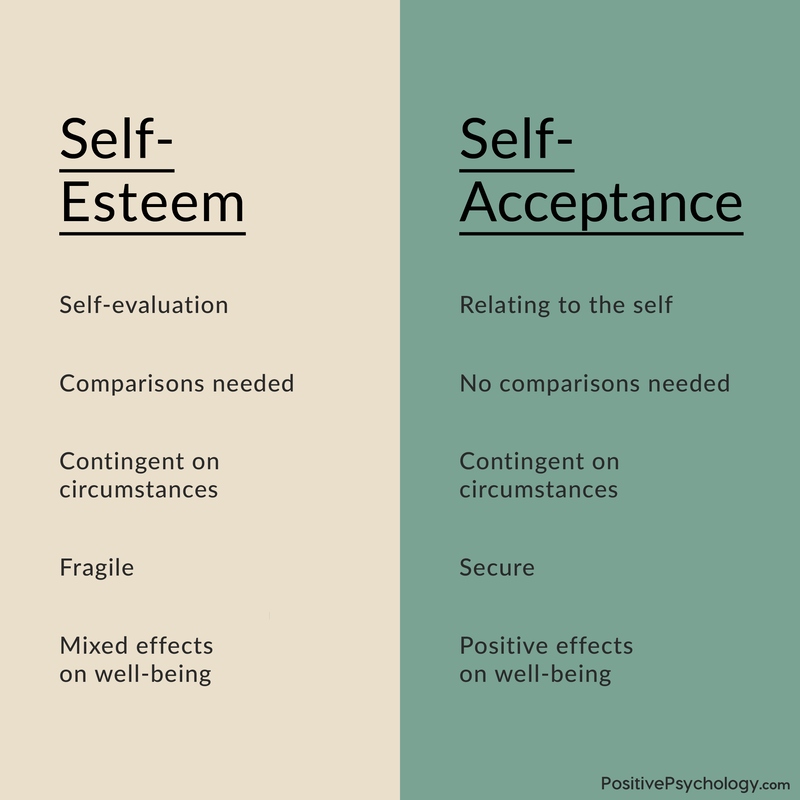
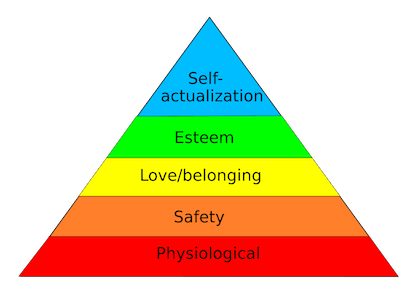
 There are certain characteristics that distinguish how high someone’s self-esteem is.